Showing posts with label African American. Show all posts

Sunday, June 27, 2010

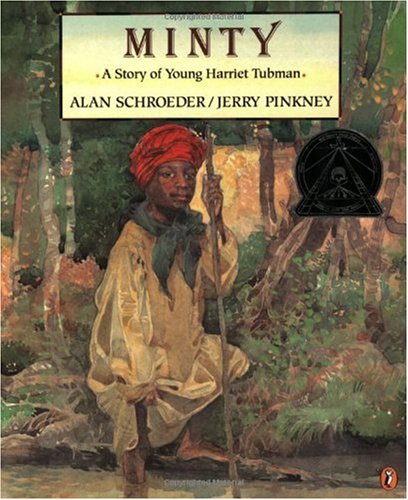
Review: Minty: a Story of Young Harriet Tubman by Alan Schroeder


Author: Alan Schroeder
Title: Minty: A Story of Young Harriet Tubman
Illustrator: Jerry Pinkney
Publisher: Dial Books for Young Readers
Publication Date: 1996
ISBN: 0-8037-1888-8


Summary:
Eight-year-old Minty (Harriet Tubman) did not want to jump at every command given to her by her owner or the overseer. She would often run and hide when she was called. One day, after spilling a pitcher of cider while serving, the mistress burned her doll, and she was sent to work in the fields. Still she dreamed of freedom, of running away. When the overseer told her to take care of the muskrat traps, Minty began to set the animals free until she was caught and beaten. Her dreams of freedom grew stronger, so her father began to train her in the woods: how to run silently, how to capture food, and how to find her way north. One night, Minty passed up a chance of escape. Crying herself to sleep, she dreamed of "a road through the forest that one day, when she had the courage, would carry her to freedom…."


Analysis:
Minty: A Story of Young Harriet Tubman is a story built around the character development of Minty. Each episode helps to define and build her personality. When her mistress orders her to appear, "Minty giggled, and then stuck out her tongue just as far as it could go." The reader knew that the next event would lead to Minty’s punishment. The Bible story of David and Goliath that she tells her doll confirms her defiant personality. After she is sent to work in the fields, it wasn’t long before Minty was dreaming of freedom. When she released the muskrats from their traps even though she knew she would be punished, Minty is shown to be a character of compassion who values freedom for all. The story then provides background information on how Minty was able to survive during her many trips on the Underground Railroad. After she was beaten, she tells her parents that she wants to escape. Her father secretly teaches her the skills she will need to survive in the woods on her own, but Minty doesn’t escape when an opportunity presents itself. The story ends with her dreaming of freedom.


The dialogue contains just enough dialect and southern phrases to give a sense of the times and the people involved, both White plantation owners and Black slaves, such as the mistress stating, "Next time, you better jump to when I call," and Minty’s mother telling her, "Your head’s in his mouth, Minty, but you sure ain’t doin’ any pattin’. You’re just fixin’ to get your head bit off."


The remainder of the text contains very little physical description of the characters. That is left to the illustrations by Jerry Pinkney. He skillfully employs watercolors to add to Minty’s character and the other characters in the story through their expressions and actions. Minty’s hair is textured in tight curls cut close to the head. Her dark brown skin even appears dusty when she works in the field. The clothing and hairstyles of all of the characters are appropriate for the times. Even the equipment and items in the background of the barn and the big house appear to be from the 1800s. The contrast between the rooms in the big house and the room in the slave’s quarters and between the clothes worn by the master and mistress versus Minty and her family add to the sense of enslavement that Minty fights with all of her heart.


Although a wonderful exploration of character development, if the reader didn’t read the author’s note at the back of the book or know the contributions of Harriet Tubman as an adult, the ending would be unsatisfactory. The author, Alan Schroeder, leads the reader to believe that Minty will escape and survive, yet Minty chooses not to leave when the time comes, and she cries herself to sleep. It is like a book in a series that leaves the reader hanging in dissatisfaction. Because of this ending, the reader must read the author’s note or book would not be able to stand alone. It would be best if paired with other books that explore Harriet’s contribution to the Underground Railroad.


Review excerpts:
Publishers Weekly (5/20/1996) "With color and feeling he (Pinkney) humanizes a historic figure, coaxing readers to imagine or research the rest of the story." (Ages 5-9)


School Library Journal (5/1/1996) ""This beautifully illustrated and moving fictional story can be used to introduce Harriet Tubman and the injustice of slavery to young audiences." (K-Gr 3)


Booklist (2/15/1996) "The blend of fact and fiction is occasionally problematic..., but kids will be moved by the picture of secret childhood rebellion in someone who grew up to lead hundreds to freedom." (Ages 5-9)


Kirkus Reviews (1996) "This exquisitely crafted book resonates well beyond its few pages." (Picture book, 5-9).


Horn Book Magazine (Sep/Oct 96) "Quick action and dialogue create a taut story, although it is illustration that shapes the characters."


Awards/Nominations/Lists:
Coretta Scott King Award for Illustration 1997
ALA Notable Book 1997
Christopher Award 1997
American Bookseller "Pick of the Lists"
Time Magazine Best Children’s Book of the Year
IRA/CBC Children’s Choice


Connections:
Expand your history lesson through the use of historical fiction picture and chapter books and biographies. Several books would provide excellent companions to Minty: A Story of Young Harriet Tubman by Alan Schroeder. Courage To Run: A Story Based on the Life of Harriet Tubman by Wendy Lawton is a story in a chapter book format that starts with Harriet’s life as a young child. Moses: When Harriet Tubman led her People to Freedom by Carole Boston Weatherford is a beautifully illustrated picture book centered on Harriet’s undying faith in God. For a nonfiction biography, Harriet Tubman: Riding the Freedom Train by Rose Blue provides a look at her life, or try Harriet Tubman: Secret Agent: How Daring Slaves and Free Blacks Spied for the Union During the Civil War by Thomas B. Allen for a look at other contributions she and other Blacks gave to our country.


For a different perspective on the Underground Railroad, try the picture books Barefoot: Escape on the Underground Railroad by Pamela Duncan Edwards, Aunt Harriet’s Underground Railroad in the Sky by Faith Ringgold, or The Patchwork Path: A Quilt Map to Freedom by Bettye Stroud. A fun way of exploring history is through the You Choose Books where the reader makes choices, and each choice leads to a different consequence based on events in history. They offer The Underground Railroad: an Interactive History Adventure by Allison Lassieur.

RSimpson

Saturday, June 26, 2010

Review: Goin' Someplace Special by Patricia C. McKissack


Author: Patricia C. McKissack
Title: Goin’ Someplace Special
Illustrator: Jerry Pinkney
Publisher: Atheneum Books for Young Readers
Publication Date: 2001
ISBN: 0-329-27980-7


Summary:
‘Tricia Ann is ready, ready to go to that Someplace Special in the city on her own. Her grandmother reluctantly lets her, giving her parting words of advice, “No matter what, hold yo’ head up and act like you b’long to somebody.” From the time she steps onto the bus with its colored section to the time she is swept into the White’s only Southland Hotel only to be told, “No colored people are allowed!” ‘Tricia Ann is confronted with the signs of bigotry and prejudism that existed in the 1950’s. In tears, she escapes to a church ruin, now a quiet garden cared for by an elderly white woman who advises her to listen close for her grandmother’s voice. “Getting’ someplace special is not an easy route. But don’t study on quittin’...,” she hears in her heart. Even though more signs of prejudism confront her, ‘Tricia Ann makes it to her Someplace Special, one of the few places that accept all people, equally... the public library.

Analysis:
Time after time, ‘Tricia Ann meets up with the signs of bigotry and prejudism that existed in the 1950’s, so much so that the story is almost overwhelming in its message of racial injustice. Most picture books with this theme focus on one or two examples of the unfairness of the Jim Crowe laws, but McKissack seems to cram as many as she can into a 32 page picture book. However, in real life, this would have been the case. ‘Tricia Ann wouldn’t have been able to choose what she saw that day or what comments would have been made to her. So, even though it’s a little overwhelming, so was the reality of the times.

Behind the message of racial injustice is a story about a plucky young girl ready and willing to face the world in order to achieve her goal. She steps out from a loving home run by a strong maternal figure (her grandmother) to confront the world with a smile on her face and confidence in her step. The speech pattern brings to the story the flavor of the Black southern dialect but in a way that even young children will be able to understand.
Pinkney’s illustrations add details of the times, from the “White’s only” signs, ‘Tricia Ann’s white bobby socks and black shoes and purse, to the fin backed cars of the 1950’s. ‘Tricia Ann with her beautifully textured hair and soft brown skin dressed in her bright turquoise blue and yellow dress contrasts with the softer, muted colors used for the people and the world around her, keeping the focus on ‘Tricia Ann and her emotional reactions to the events in her life. Pinkney’s illustrations are what make this a story about ‘Tricia rather than solely a treatise against prejudism. ‘Tricia Ann is the link that pulls the reader into the story, making it believable, allowing the message to take heart.
The addition of an author’s note relating her personal experiences during the same era help the reader to realize that this story is semi-autobiographical. Patricia McKissack, too, found refuge in one of the few places that treated everybody equally. Yes, it was the public library.

Review excerpts:
Booklist
(August 2001) “Pinkney’s watercolor paintings are lush and sprawling as they evoke southern city streets and sidewalks as well as ‘Tricia Ann’s inner glow.... This book carries a strong message of pride and self-confidence as well as a pointed history lesson.” (Ages 5-8)

Horn Book (November/December 2001) “McKissack and Pinkney strike just the right balance in a picture book for young readers and listeners: informative without being preachy; hopeful without being sentimental.”

Kirkus Review (September 2001) “Every plot element contributes to the theme.... A natural for group sharing; leave plenty of time for the questions and discussions that are sure to follow.” (5-9)

Library Talk (March/April 2002) “This book... would be a wonderful addition to library and school collections. Recommended.”

Publishers Weekly (August 6, 2001) “Pinkney’s... luminescent watercolors evoke the ‘50s, from fashions to finned cars, and he captures every ounce of ‘Tricia Ann’s eagerness, humiliation and quiet triumph at the end.” (Ages 4-8)

School Library Journal (September 1, 2001) “A thought-provoking story for group sharing and independent readers.” (Gr 3-5)

Awards/Nominees/Lists:
Coretta Scott King Awards Winner 2002 Illustrator
ABC Children’s Booksellers Choices Award Winner 2002 Picture Books
Monarch Award Master List (IL) 2007
ALA Notable Children’s Books 2002
The Best Children’s Books of the Year 2002 Bank Street College of Education
Black-Eyed Susan Book Award Nominee 2003 (Maryland)
Colorado Children’s Book Award List 2003
Delaware Diamonds 2003
Georgia Children’s Literature Awards 2003
Kentucky Bluegrass Award 2003
Louisiana Young Readers’ Choice Award 2003
Pennsylvania Young Readers’ Choice Award 2002-2003
Texas Bluebonnet Award 2004

Connections:
As school history books are politically edited, toning down the importance of various events and people in history or cutting them out altogether, it becomes even more important to bring history lessons to life by using literature such as Goin’ Someplace Special by Patricia C. McKissack. Read other books like Rosa by Nikki Giovanni, Freedom on the Menu: The Greensboro Sit-Ins by Carole Boston Weatherford, My Brother Martin by Christine King Farris, The Story of Ruby Bridges by Robert Coles, and Through My Eyes by Ruby Bridges. Every one of these books adds to the sense of the times.
If you’re daring, try an exercise on prejudism with the children. For example, people who can fold their tongues will get to line up first, get a drink from the closest water fountain, use the closest bathroom, sit in the closest desks. Then switch and make it the people who cannot fold their tongues who get the privileges. Follow this exercise and the book readings up with a class discussion. How did you feel when...? How do you think people of color felt when the Jim Crow laws were in effect? Close with an emphasis on the injustice of those laws and the unfairness of prejudism. Most children understand when something is unfair. Hopefully, this lesson will never be forgotten, unlike the history textbook.


RSimpson

Sunday, June 20, 2010

Review: Hush by Jacqueline Woodson


Author:
Jacqueline Woodson
Title: Hush
Publisher: G.P. Putnam’s Sons
Publication Date: 2002
ISBN: 0-399-23114-5


Summary:
Toswiah had everything: a best friend, a grandmother living nearby, a happy home with a father who was a police officer and a sister who was a cheerleader. Then her world came crashing down. Her father, the only Black officer in his precinct, witnessed two fellow officers, friends of the family, gun down an unarmed boy. Why? Although the boy was a good student from a respected family, he was Black. When her father chose to testify, Toswiah’s family became the victims of death threats. One night, some men came and put the whole family into protective custody. They left everything behind except what they could carry in plastic bags. Even their names were changed. Toswiah Green from Colorado was no more. Evie Thomas from California was born. How would you cope? Her mother finds a new religion. Her sister finds refuge in studying. Evie discovers the joy in running, but her father loses himself, staring out the window. Who is Evie now, and will her new world survive? (Woodson, Jacqueline. 2002. Hush. New York: G.P. Putnam's Sons. ISBN: 0399231145)

Analysis:
Many have heard of the Brotherhood, the bond between police officers, where the color of a person’s skin is not important. It’s the trust between the officers that allow them to survive the harsh realities on the streets. Sometimes, though, bad things happen, and an officer must choose between the Brotherhood and the truth. Hush by Jacqueline Woodson places a Black family in a middle class neighborhood in Colorado into this situation. The Green family is uprooted from everything they know and has to rediscover who they are in a new neighborhood, with new names.

The characters in Hush reflect their culture, but they are not stereotyped. Details of each are brought out in beautifully written text. “The mother’s dark brown fingers move quickly through a rise of white dough. On the stove, chicken pieces, seasoned and dipped in flour, sizzle.” Toswiah loves the beauty of her mother. “Her mother’s brown reminds her of everything she loves: Chocolate. Dark wool. The smell of earth. Trees.” The girls’ skin is “somewhere between their mother’s deep brown and their father’s lighter skin.” Their father calls them his “copper pennies.”

The universal theme of finding oneself is magnified given the intense situation this family finds itself in. Each character evolves in his/her own direction as they face the challenges of a new life. Cameron/Anna who was the popular one, finds a goal in education, a way to escape their depressing home. The mother finds religion. Maybe, if she believes hard enough, her world will turn around. Toswiah/Evie discovers running. “I want to keep running, past these ghosts, past everyone and everything....” The father slowly dies, staring out of the window, until he tries to take his own life. Only then does he face what he almost lost – his family. “I am so glad I’m alive, Evie. So glad we all are.”

Some of the issues faced by the African American are brought to the forefront, such as dating in a mixed relationship, working in an all-White world, and having an innocent boy shot down just because he is Black. These issues are brought to life when combined with the personal changes the father’s decision made in the lives of his family. They are not just political issues; they are issues that affect individual people. People the reader comes to know and care about.

Review excerpts:
Horn Book (January/February 2002)
“Her (Woodson’s) poetic, low-key, yet vivid writing style perfectly conveys the story’s atmosphere of quiet intensity.”

Kirkus Review (October 15, 2001) “”She’s (Woodson) interested in exploring what makes the core “I am” of a person, who they are when everything – friends, community, profession, even their names – has been stripped from them. Intellectually engaging yet strangely unmoving, this unusual story about a cut-off child seeking to reconnect and belong will give youngsters plenty to think about.” (10-14)

Publishers Weekly (December 10, 2001) “Readers facing their own identity crises will find familiar conflicts magnified and exponentially compounded here, yet instantly recognizable and optimistically addressed.” (Ages 10-up)

School Library Journal (February 1, 2002) “This multifaceted novel from the talented Woodson may be too introspective for some readers, but those sophisticated enough to manage the intricacies of the story will come away with images and characters who are impossible to forget.” (Gr 6-9)

Awards:
National Book Award nominee
2003 ALA Best Book for Young Adults
SLJ Best Book
002 Booklist Editor’s Choice
2003 New York Public Libraries Books for the Teen Age
Bank Street Best Children’s Books of the Year (“Today” category/ 12 & up)
2003 Riverbank Review Children’s Books of Distinction Short list
2003-2004 Dorothy Canfield Fisher Award Master List
2003-2004 Maine Student Book Award Mater List
2002 Pennsylvania School Librarians Association Young Adult Top 40 Nominees
2004-2005 Maud Hart Lovelace Book Award Nominee (Grades 6-8)
2005 Garden State Teen Book Award Nominee

Connections:
As a means of exploring the Witness Protection Plan from a different perspective, try pairing this book with the book Zach’s Lie by Roland Smith for grades 6 and up. Although not a multicultural book, the family in this book is placed into the Witness Protection Plan in order to protect them from drug traffickers that their father had gotten involved with. How do Zach and his family cope with new identities? Expand this one step further through a creative writing experience. How would you cope? Who would you become while keeping true to yourself? If teaching high school students, read excerpts from WITSEC: Inside the Federal Witness Protection Program by Pete Earley and Gerald Shur to add non-fiction accounts from real people in the program. How do the fiction family’s lives and emotions compare to those who really had to change their identities?


RSimpson